
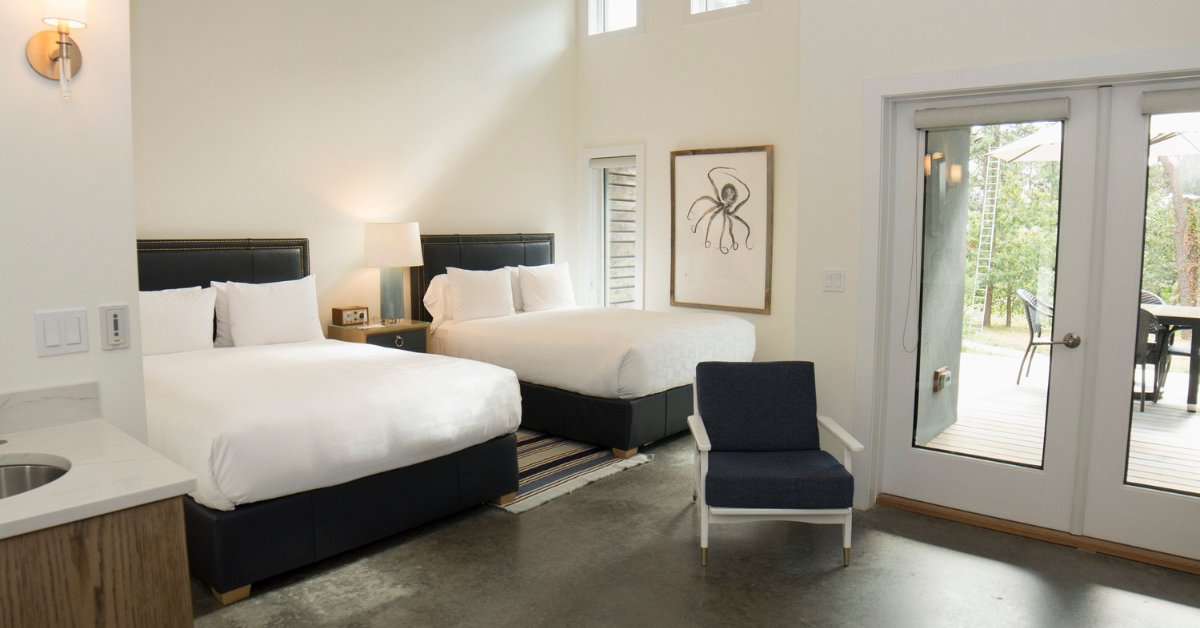
Yes — a VRBO or vacation rental is reimbursable under Temporary Lodging Expense.
JTR Table 5-16 explicitly authorizes reimbursement for “a furnished or unfurnished apartment, house, mobile home, or recreational vehicle” when Government quarters are not available. A vacation rental is a furnished house. It qualifies.
There are conditions you have to meet first, and the receipt requirements are stricter than most people expect. Plus, certain branches and other organizations have stricter requirements.
Remember: your approval authority is your gaining installation, so when in doubt, call ahead.
Otherwise, here’s what to know before you book that VRBO near JBLM with the sweet pool.
The Two Conditions That Must Be Met First
Before you book anything, two things have to happen in the right order.
1. Check Government Quarters First
Per JTR Table 5-16, if Government quarters are available at your installation, you are required to use them before booking commercial or private lodging.
If you skip this step and book a vacation rental instead, your TLE reimbursement is capped at the Government quarters rate or the locality lodging rate — whichever is lower. That cap may be significantly less than what you paid.
2. Get a Non-Availability Confirmation Number
If Government quarters are not available — which is common during peak PCS season — you are required to obtain a non-availability confirmation number from your installation’s lodging reservation process before booking commercial or private lodging. This applies to vacation rentals the same as hotels.
Get the number first, then book. Keep the confirmation number with your travel claim documentation.
There is one exception: if family-type Government quarters are under renovation, or your HHG has been packed and shipped but not yet received, commercial or private lodging is authorized without a non-availability number per Table 5-16, Row 3.
The Lodging Cap
Before you get too excited about a beachfront VRBO near Camp Pendleton, know that your nightly rate must be at or under the locality lodging cap — which is currently $110/night for most CONUS locations. Lodging taxes are reimbursable separately and do not count against the cap per FTR 301-11.27.
If you book on a weekly rate, your nightly rate is calculated by dividing the total weekly cost by the number of nights:
- A $700/week rental works out to $100/night — under the cap.
- A $900/week rental works out to $128/night — over the cap. In this case, you’d only be reimbursed up to the cap amount, not the full cost.
The overall TLE daily cap is $290, which covers both lodging and M&IE. For a family of four, M&IE alone can run $150-190/day, which leaves $100-140 for lodging before you hit the ceiling. Weekly rates on vacation rentals are often the only way to stay under that number comfortably.
What Your Receipt Must Show
This is where most people run into problems. DFAS is explicit about what a valid receipt requires for vacation rental TLE claims:
- Service member’s name on the receipt
- Itemized nightly room rate. This is per night, not a weekly lump sum
- Taxes. Itemized separately per night, not combined with fees
- Location of the stay
The critical issue: VRBO’s default receipt often shows a weekly total with taxes and service fees combined into a single line item.
Per JTR par. 020303-A4, “only itemized charges are considered for reimbursement.”
If taxes and fees are combined on one line, only the nightly room rate is reimbursable — not the taxes.
After booking, contact your host or VRBO directly and request an itemized receipt showing the nightly rate and taxes as separate line items for each night. Most hosts can provide this. If they cannot, use the Statement in Lieu of Receipt form — some offices accept this when the platform receipt doesn’t meet itemization requirements.
What Fees Are and Aren’t Reimbursable
DFAS is clear on this. Service fees, resort fees, and tourism fees are not authorized lodging expenses unless specifically approved by an authorized official.
Cleaning fees are a gray area — the JTR language for long-term lodging includes cleaning fees in the cost calculation, but DFAS guidance says they are generally not covered without pre-approval. When in doubt, ask your finance office before booking.
What is reimbursable as part of the lodging cost up to the daily cap: nightly room rate, lodging taxes, and any mandatory fees that are disclosed upfront as part of the rental cost.
Before You Book: Talk to Your Finance Office
TLE policy implementation varies by branch and installation. Some finance offices require pre-approval before booking non-conventional lodging. Some have specific documentation requirements beyond what the JTR requires. Calling your finance office before you book can save you a significant out-of-pocket loss.
Questions to ask:
- Does this installation require pre-approval for vacation rental TLE claims?
- What documentation do you require beyond the itemized receipt?
- Is there a Statement in Lieu of receipt form if my host can’t provide itemized nightly receipts?
The Short Version: Your Pre-Booking Checklist
- Contact your installation’s lodging office and attempt to book Government quarters
- If Government quarters are not available, obtain a non-availability confirmation number
- Call your finance office and confirm their documentation requirements for vacation rental TLE claims
- Find a VRBO at or under $110/night (or a weekly rate that averages to that or under)
- After booking, request an itemized receipt showing nightly rate and taxes separately per night
- Keep your non-availability confirmation number, booking confirmation, and itemized receipt
- Submit your claim within your installation’s required timeframe
Frequently Asked Questions
Yes. JTR Table 5-16 explicitly authorizes reimbursement for “a furnished or unfurnished apartment, house, mobile home, or recreational vehicle” when Government quarters are not available.
Two conditions apply: you must attempt to book Government quarters first, and if they’re unavailable, you must obtain a non-availability confirmation number before booking the vacation rental.
Yes — same rules as VRBO. The JTR authorizes reimbursement for any furnished or unfurnished house or apartment when Government quarters are not available. The platform doesn’t matter. The receipt requirements and non-availability confirmation number requirement apply regardless of which platform you use.
Your receipt must show the service member’s name, the itemized nightly room rate per night, taxes itemized separately per night, and the location of the stay. A lump sum receipt that combines taxes and fees into one line is not sufficient — only the room rate will be reimbursed. Request an itemized receipt from your host after booking.
Generally no — DFAS guidance states that service fees and cleaning fees are not authorized lodging expenses unless approved by an authorized official. Ask your finance office before booking if you want cleaning fees covered. Don’t assume they’re included.
A non-availability confirmation number is issued by your installation’s lodging reservation process when Government quarters are not available. It’s required before booking commercial or private lodging — including vacation rentals — for TLE reimbursement. Contact your installation’s lodging office to request one if on-base lodging is full.
The standard CONUS lodging cap is $110/night. Lodging taxes are reimbursable separately and do not count against this cap. The overall TLE daily cap — covering both lodging and M&IE — is $290. Your actual reimbursement depends on your household size and locality per diem rates. See our TLE calculation guide for the full breakdown.


